The question
In our CAISO study we found two things about the day-ahead versus real-time settlement price: the day-ahead price runs a small but real premium over real-time, and the gap between them — once its daily rhythm is stripped out — still carries hour-to-hour memory. That raises an honest question the CAISO data alone can’t answer: is this a quirk of one grid, or a property of the two-settlement market design itself? The clean way to tell is to hold the mechanism fixed and change the grid — run the identical instrument on an independent system operator and see whether the same structure appears.
Data
NYISO’s public Market Information System, zonal locational marginal prices (LBMP): day-ahead (hourly) and real-time (~5-minute) settlement prices for the New York City zone, over six complete calendar months (February–July 2026). NYISO is an independent grid with directly accessible public data — no account, no key. We also carry the Capital zone as a within-grid check (more on why that is a check, not a second grid, below). Every figure here is our own derived analysis, not redistributed raw data.
Method
Same engine, same estimator, same pre-registered gates and null as the CAISO study — only the data source changes, which is exactly what makes this a test rather than a re-parameterization. The basis is real-time minus day-ahead LBMP (the total price, $/MWh; we keep, but never subtract, the loss and congestion components). NYISO’s five-minute real-time prices are interval-ending, so each is assigned to the hour it falls within — a convention we self-test and which does not move the hourly result — and averaged onto the day-ahead hourly clock. We report a robust center (median) so scarcity spikes are kept but cannot dominate, remove the day-of-week-and-hour rhythm, then test the leftover for serial structure against a value-permutation null with every parameter fixed before any data was touched. Eastern time throughout, including the spring-forward hour.
Findings
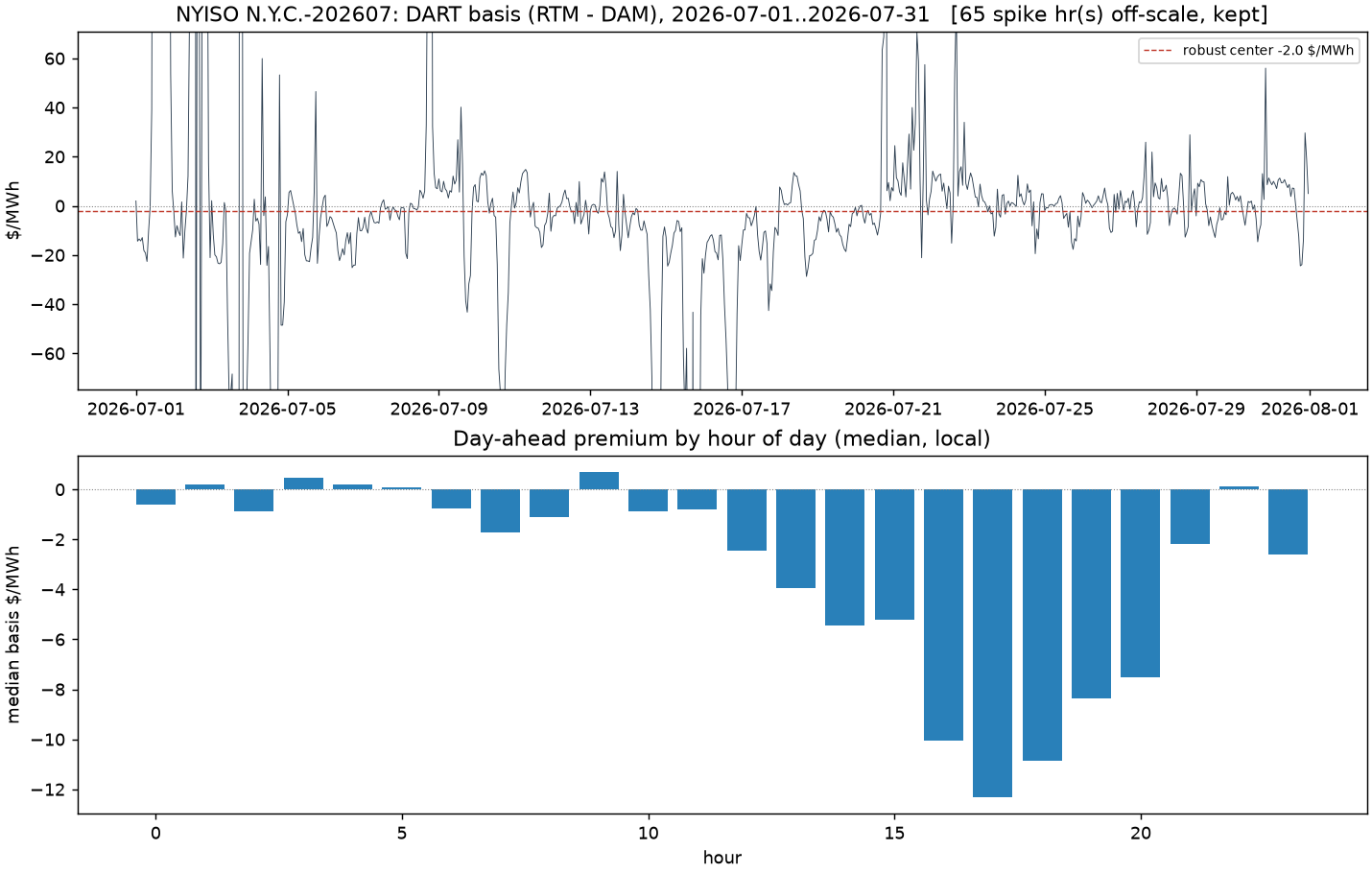
Across all six months, the day-ahead premium is present and statistically significant. In New York City the median real-time-minus-day-ahead basis is negative in 6 of 6 windows — day-ahead richer — and its bootstrap 95% interval excludes zero in every one, ranging from roughly −7% of the day-ahead price in late winter to a small but still-significant −2.7% (about $1/MWh) in the mildest spring month.
| Month | RT−DA median ($/MWh) | 95% CI | % of DA | Lag-1 ACF | z vs null |
|---|---|---|---|---|---|
| Feb 2026 | −4.28 | [−5.57, −2.60] | −5.2% | +0.65 | +17.8 |
| Mar 2026 | −3.14 | [−4.13, −2.21] | −6.9% | +0.35 | +10.3 |
| Apr 2026 | −1.03 | [−1.39, −0.47] | −2.7% | +0.35 | +9.6 |
| May 2026 | −2.00 | [−3.06, −1.29] | −5.3% | +0.36 | +9.9 |
| Jun 2026 | −1.80 | [−2.66, −1.23] | −4.0% | +0.41 | +11.9 |
| Jul 2026 | −2.00 | [−3.03, −0.91] | −3.7% | +0.50 | +15.2 |
The deseasonalized basis shows clear positive persistence in every window — lag-1 autocorrelation around 0.35–0.65, far above anything value-shuffled versions of the same series produce (z from +9.6 to +17.8). In other words, after the predictable daily-and-weekend pattern is removed, the day-ahead-vs-real-time surprise still has memory from one hour to the next. The premium is strongest and most persistent in winter and milder in summer — consistent with Northeast cold-snap gas dynamics, where forecast errors and price divergence run largest.
The Capital zone tells the same story, but it is a within-grid corroboration, not an independent second test: two zones on one grid share the system-wide energy component and move largely together, so agreement between them guards against a zone-specific fluke and nothing more. The two real axes of this study are temporal (six months) and cross-grid (NYISO versus CAISO).
Set against CAISO, the direction matches: the same day-ahead premium, the same positive persistence. Read directionally — not as a pooled statistical test — NYISO’s premium is somewhat milder in percentage terms than CAISO’s (about −9%), while its persistence runs a little higher (~0.35–0.65 against CAISO’s ~0.30). A plausible reason is that New York City is import-constrained, so congestion and forecast-error divergence linger across hours; we offer that as a hypothesis, not something we have adjusted for.
What this means
The day-ahead premium and its persistence are not a CAISO artifact. Holding the two-settlement mechanism constant and swapping to an independent grid, the same structure appears — which lifts the finding from “true on one market” to “a property of this market design.” The honest boundaries: this is six recent months, winter into summer, not a year-round claim; one grid plus a correlated companion zone, not a battery of independent grids; and it is a measurement, not a trade. The day-ahead-vs-real-time spread is settled and, in principle, tradable through virtual bidding — but this study measures the premium and its predictability only. It makes no claim that either is capturable after costs, and offers no buy, sell, or allocation advice.