The question
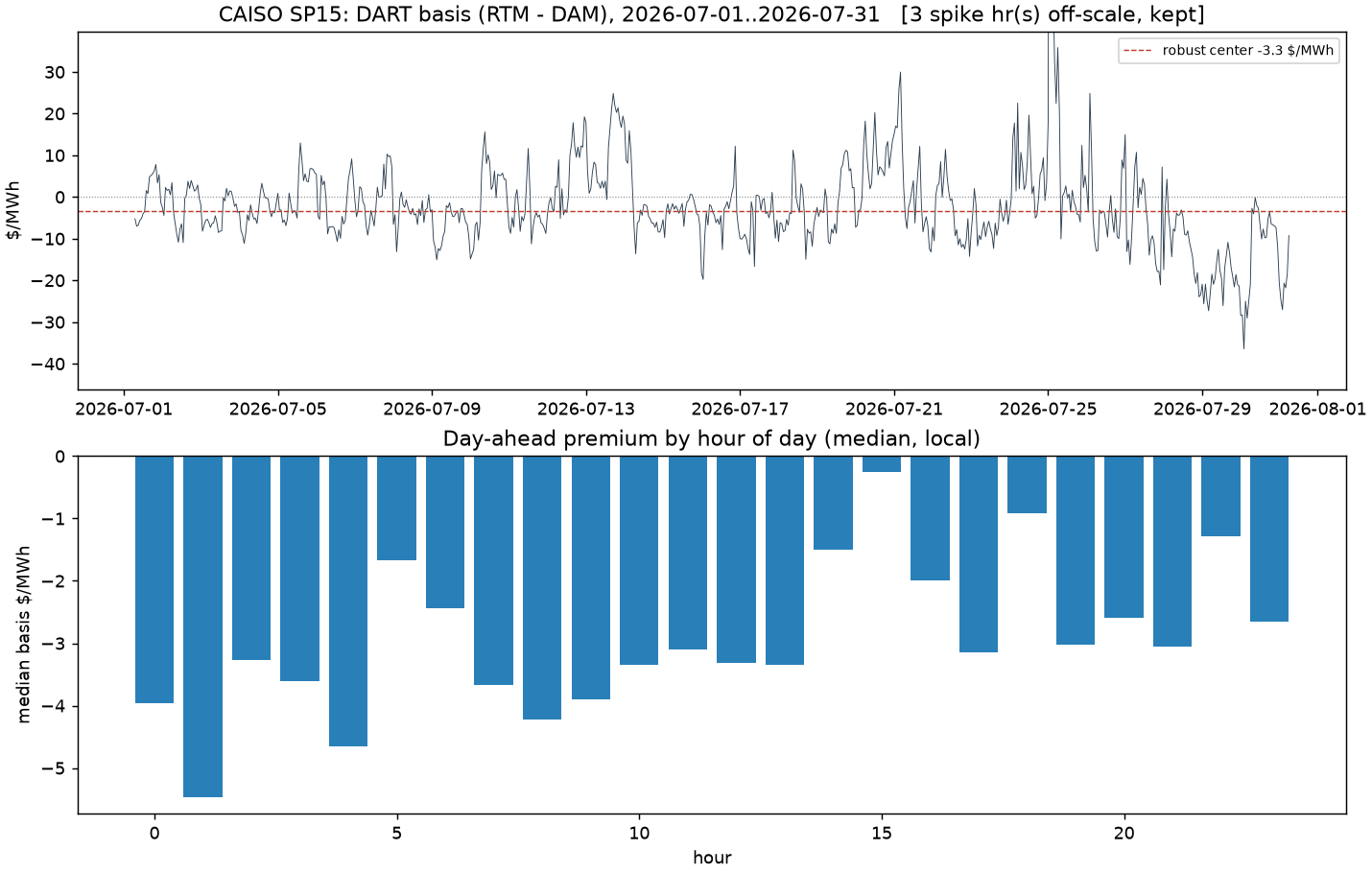
Wholesale electricity clears twice. A day-ahead market (DAM) sets hourly prices the day before; a real-time market (RTM) settles every few minutes. The difference — the DART basis, real-time minus day-ahead — is where forecast error and scarcity land. Two honest questions: is there a systematic day-ahead premium, and once the daily rhythm is stripped out, is the basis predictable from its own recent past?
Data
Public hourly day-ahead and 15-minute real-time locational prices from CAISO’s OASIS, for the SP15 trading hub over July 2026 (30 days, 720 hours), with NP15 as a replication hub. The real-time leg is averaged to the hour and aligned to day-ahead on one clock. Both legs are in $/MWh, so no currency normalization is needed.
Method (and a null we had to correct)
We reconstruct the hourly basis, then remove its hour-of-day and weekday/weekend rhythm before testing for structure. The reversion test from our crypto studies — an increment-shuffle surrogate — is the wrong tool here: the DART basis is a stationary settlement series, and that surrogate would flag even a perfectly efficient basis as “reverting.” We confirmed this on synthetic controls before touching any data, and replaced it with the correct null — an i.i.d. permutation of the residual values, against which we test the basis’s autocorrelation. Negative prices and scarcity spikes are real market events and are kept, not deleted; every statistic uses a robust center so no single spike dominates.
Findings
SP15 carried a genuine day-ahead premium: real-time settled about $3.3/MWh below day-ahead at the median hour (roughly −9% of the price; 95% CI −$3.7 to −$2.9), with real-time below day-ahead in two hours out of three. After deseasonalizing, the basis showed clear predictable persistence — hour-to-hour autocorrelation of +0.30 (z +15 against the permutation null), decaying smoothly over several hours. NP15 replicated both: a smaller premium (about −4%) and stronger persistence (+0.70). Across both hubs the qualitative result is identical; only the magnitude is location-specific.
What this means
The engine detects and quantifies real structure — a day-ahead premium and a measurable, decaying predictability — both well documented in power markets, and it does so only after rejecting a null that would have manufactured the result. This is a single-month, two-hub window: genuine here, with replication across seasons ongoing. It is monitoring-grade measurement of market structure, not a trading recommendation.