The question
Our first look at this identity, over a single week, found the ETHBTC residual tiny and sharply mean-reverting, and we called it a genuinely binding no-arbitrage force. We flagged it openly as single-window. Two questions were left: does the identity hold in other periods — and, the sharper one, is that reversion a real force pulling the two quotes together, or just the arithmetic of a coarsely-quoted price rounding toward a finer reference?
Data
Six one-week windows (Monday 00:00 → Monday 00:00 UTC) spread across January–August 2026, fixed in advance by a mechanical 42-day step before any residual was examined, using public one-minute closes for ETHBTC, ETHUSDT and BTCUSDT from a single exchange (Binance): 10,080 aligned minutes per window, 60,480 in all. Every figure is our own derived analysis, not redistributed data. The earlier single-window run left no saved bounds to reproduce exactly, so the most recent window here overlaps that period only approximately and is labelled as such; the five independent windows carry the weight.
Method
The shared USDT numeraire cancels when ETHUSDT is divided by BTCUSDT — that cancellation is this domain’s normalization step — leaving one residual series in basis points: the traded ETHBTC price minus its implied value. We guard it with a robust outlier filter, draw an explicit three-leg cost band (a triangular round trip pays three taker fees; retail, mid and institutional tiers), and test the residual against not one null but two, with every parameter fixed in advance:
- an increment-shuffle surrogate — the series with its mean-reversion destroyed but its step sizes kept, i.e. a random-walk twin;
- a quantization null — the implied rate rounded to the direct leg’s own tick, which reproduces the mechanical reversion you would see if the ETHBTC quote were nothing but a coarsely-rounded shadow of the implied rate.
The second null is what this study turns on. The ETHBTC tick is about 3.2 basis points; the implied rate is thousands of times finer. So whenever implied drifts a fraction of a tick, the direct quote snaps to the nearest tick and the residual collapses toward zero — reversion with no arbitrage content. The pre-registered rule: to call the reversion a genuine binding force, it must clear the random-walk floor and beat the quantization null by a set margin.
Findings
The identity holds, it is untradable — and the “binding force” does not survive the stricter null.
Bound to within a tick. Across all six windows the residual’s largest single excursion ran from 6.2 to 13.8 basis points, and it never reached the mid (15 bps) or retail (30 bps) fee band in any of the 60,480 minutes. Only the most generous, fee-only institutional band was ever touched — on at most 0.8% of minutes in the most volatile week, and 0.1% or less in the others — and those minutes reverted almost at once (the great majority within three minutes). A version of that band that also charges a realistic spread on each of the three legs was cleared on three minutes in the entire study. There is no tradable dislocation.
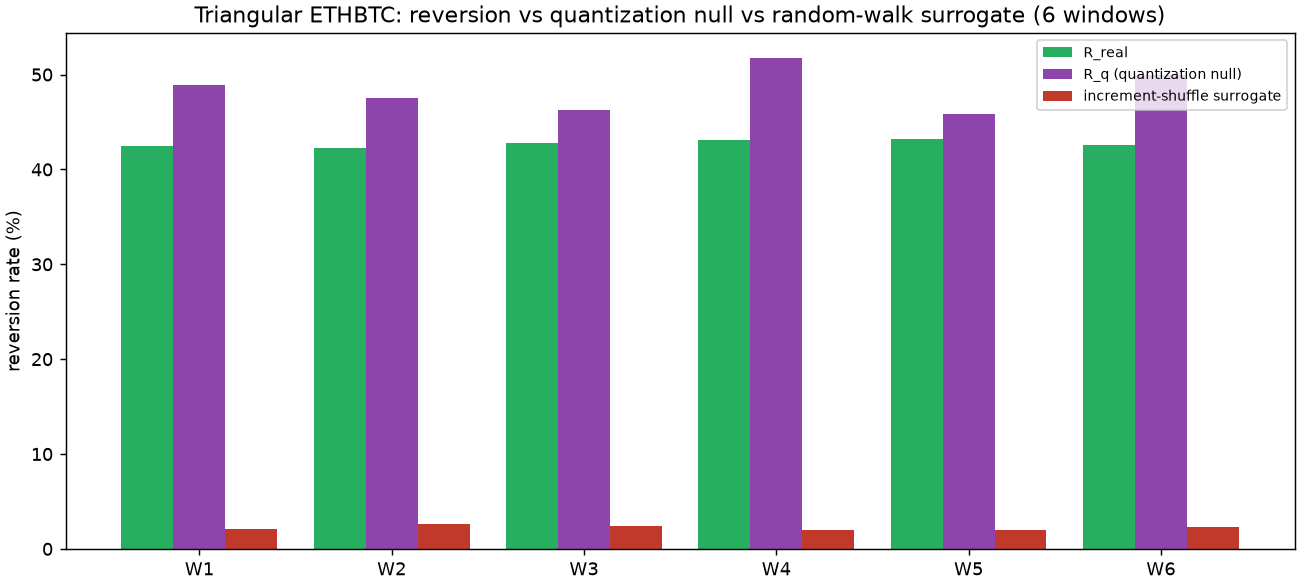
Reverts — but it is quantization, not a force. Against the random-walk surrogate the residual mean-reverts strongly and consistently: roughly 42–43% convergence in every window versus about 2% for the surrogate, tens of standard deviations clear. On that null alone we would call it a binding force — which is exactly what our single-window note did. But against the quantization null the reading inverts: rounding the implied rate to the tick reverts even more — 46–52% in every window — so the real residual reverts slightly less than a coarsely-rounded shadow would, not more. In all six windows the reversion fails to beat the quantization null.
| Window | max |resid| (bps) | reversion (real) | random-walk surrogate | quantization null |
|---|---|---|---|---|
| W1 (Aug 17, approx-overlap) | 13.8 | 42.5% | 2.1% | 48.9% |
| W2 (Jul 6) | 8.5 | 42.3% | 2.6% | 47.5% |
| W3 (May 25) | 6.8 | 42.8% | 2.4% | 46.2% |
| W4 (Apr 13) | 6.2 | 43.1% | 1.9% | 51.8% |
| W5 (Mar 2) | 6.4 | 43.2% | 2.0% | 45.9% |
| W6 (Jan 19) | 6.4 | 42.6% | 2.3% | 50.0% |
In every window the real reversion sits far above the random-walk surrogate but below the quantization null — the signature of rounding, not of a force acting faster than the tick.
What this means
We pre-registered a stricter test of our own most confident earlier claim, and it downgraded it. The no-arbitrage identity is real and holds tightly: the traded and implied ETH/BTC prices agree to within one quote tick across eight months, and the gap is decisively untradable at any realistic cost. But the mean-reversion we had read as a binding economic force is, under the stricter null, indistinguishable from — and slightly weaker than — the mechanical reversion of rounding a fine price to a coarse tick. The honest statement is narrower and truer: the identity is consistent to within a tick, not dynamically enforced faster than that tick.
None of this is a trading claim. The residual is a few basis points, it never clears a realistic cost band, and the reversion carries no exploitable content. This is monitoring-grade measurement, not investment advice — and the value of the note is the correction, the same shape as when a pre-registered replication turned an apparent SOL funding-basis edge into a window-specific artifact.