The question
A stablecoin promises a dollar. Peg integrity has three measurable parts: how far the price drifts from $1, whether independent venues agree on that drift, and — when it drifts — whether it holds a fixed, self-correcting level or simply moves.
Data
Two public one-minute windows. A ~7-day window of USDT/USD on Coinbase (about 10,000 aligned minutes) for the level-and-drift picture, and a ~12-hour window of USDT/USD on Kraken and Coinbase for cross-venue agreement (Kraken’s public history caps near twelve hours). USDC/USD on Kraken over the short window. DAI/USD was dropped before any analysis — Coinbase has delisted it and Kraken’s book was 97% zero-volume, meaning carried-forward quotes rather than real trades. Rejecting a dead market is the instrument’s first job, not an afterthought.
Method
We measure each venue’s deviation from $1 in basis points, check cross-venue agreement, and cost the cross-venue gap against round-trip fees. For the 7-day series we then run a pre-registered stationarity test — an augmented Dickey–Fuller test plus an increment-shuffle surrogate on the demeaned series, every parameter fixed in writing before the data was seen — to ask whether the discount reverts to its own level or drifts.
Findings
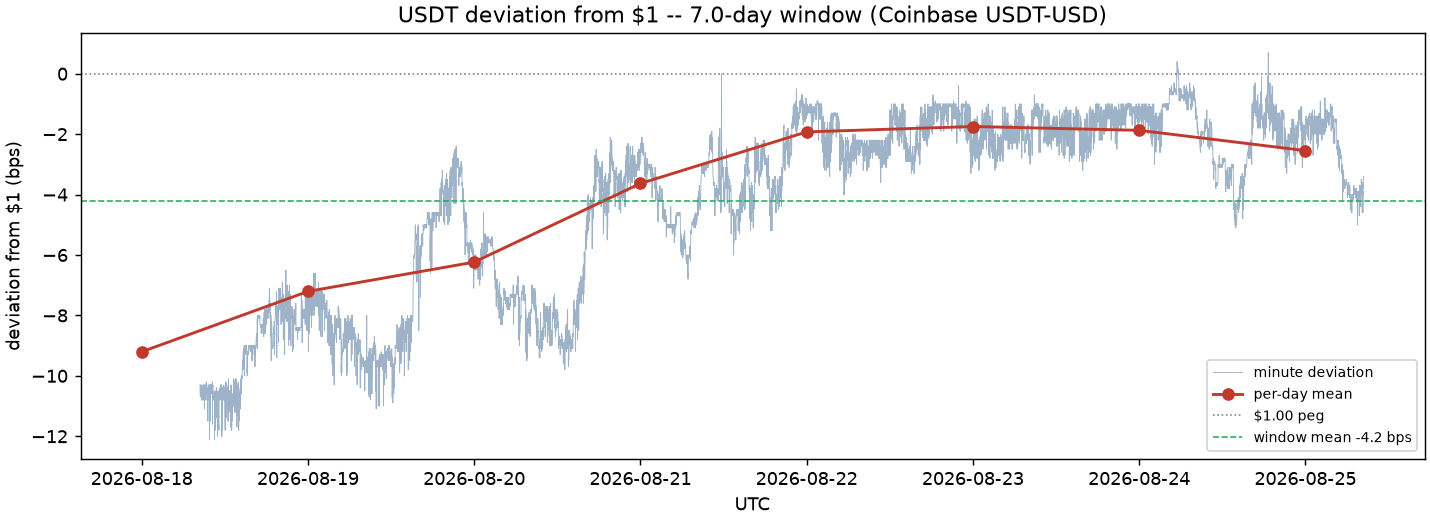
Over the week, USDT sat at a larger discount than any short snapshot suggests, and a moving one. The deviation averaged about −4 bps and narrowed steadily from roughly −9 bps early in the week to about −2 bps at the end. That drift is why the series does not test as stationary: the Dickey–Fuller test cannot reject a random-walk-like unit root (p ≈ 0.13), and the demeaned deviation reverts no faster than its surrogate. One week of one-directional narrowing is an observation, not a proven self-correcting force.
Yet the venues agree on where USDT is. Over the twelve-hour two-venue window Kraken and Coinbase differed by about half a basis point, agreeing in sign on every larger deviation (497 of 497), and the cross-venue gap — the only part that is actually a market trade — never came within reach of trading costs. A discount from $1 is not itself a dislocation to trade: par is reached by redeeming with the issuer, not by a market order, so a wide discount is an integrity signal, not a free lunch. USDC held inside ±1 bp all window, tighter than the venue’s quoting can resolve.
What this means
Peg integrity is several properties at once, and the same engine separates them honestly: independent venues concur on USDT’s price to within a basis point, while the price itself carried a multi-basis- point discount that moved across the week and does not test as stationary. This is integrity monitoring, not a trade — nothing here clears cost, and none of it is advice.