The question
An on-chain automated market maker can only reprice when a new block lands; a centralized exchange reprices continuously. The intuitive story is that the DEX must lag the CEX by about one block — the time it takes to observe the exchange move and land a transaction on-chain. Is that lag actually measurable, or does it hide below the block clock?
Data
Binance ETHUSDT trades as the continuous reference, against the Uniswap v3 USDC/WETH 0.05% pool taken as one price per block. Two chains: Ethereum mainnet (~12-second blocks) and Base (~2-second blocks). A public exchange API and free RPC endpoints, nothing paid. This is a timing study — who moves first — so the small USDC-versus-USDT stablecoin basis, a price-level effect, is deliberately left out.
Method
Lead–lag by the Hayashi–Yoshida estimator on asynchronous ticks. The block cadence is a hard resolution floor: a lead is only real if it exceeds the block time. Each window carries a block-quantization control — the apparent lead that block sampling manufactures on its own — and any genuine lead must be both sharper than that control and larger than the floor, with a small extra allowance on the L2 for sequencer-clock drift. Every parameter was fixed before the data was seen.
Findings
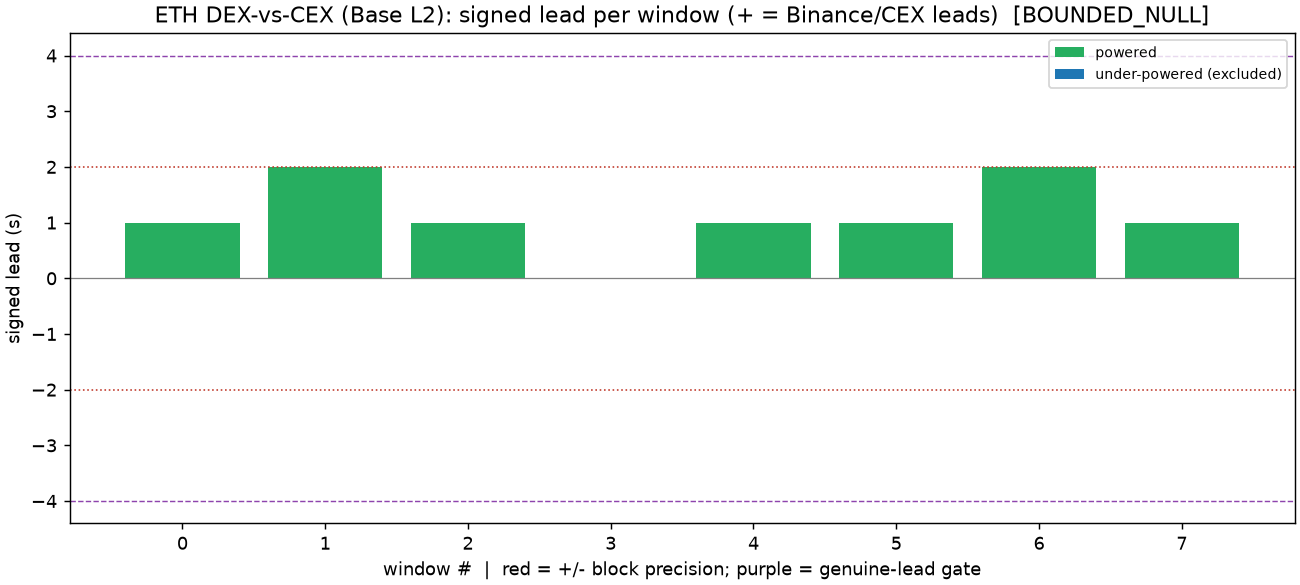
Mainnet’s 12-second floor is too coarse to see a one-block lead — it is a bounded null by construction, and the powered windows were flat with only a faint CEX-first sign. So we escalated to Base, whose 2-second blocks drop the floor sixfold. Across eight powered windows the on-chain price tracked the exchange contemporaneously: every window’s lead sat at or below the two-second floor (0 to 2 seconds), consistently CEX-first — the right direction — but never sharp and large enough to clear the gate. Zero of eight resolved. The DEX adjusts to the CEX inside a single 2-second block.
What this means
A different kind of venue — an on-chain pool rather than an order book — and the same honest verdict: a faint, correctly-signed lead that never becomes resolvable, even after tightening the clock sixfold. There is a real tendency for the exchange to move first; the on-chain follow-up is simply faster than two seconds. Mid-build the engine also caught and discarded one of its own spurious readings — a truncated data window that briefly faked a 33-second DEX lead — before it reached any record. This is measurement of market structure, not a trade.