The question
Our BTC study found no measurable lead between exchanges — the venues move together. A liquid altcoin is the natural stress test: alts are sometimes less tightly arbitraged, so SOL might reveal a resolvable lead where the major did not. Same venue pair, same estimator, one honest question — does the alt lead?
Data
Trade-level (tick) data for SOL from Binance (SOLUSDT) and Coinbase (SOL-USD), collected as 14 non-overlapping 20-minute windows across a single day, spanning both quiet and active hours. A lead-lag study measures timing, not price level, so no de-margining is required here: the stablecoin basis moves the level of a quote, not which venue moves first.
Method
Each window is estimated with the Hayashi–Yoshida estimator, the correct tool for asynchronous ticks. Timing resolution is bounded by the sparser venue, so we pre-register a power gate — a window counts only if the second venue ticked densely enough, the venues genuinely co-moved, and enough ticks were present — and we draw the verdict only from windows that pass it, against a pre-registered resolution floor. The estimator ships an offline self-test that recovers a known injected lead and returns zero when two asynchronous samplings share one underlying price, proving that asynchronicity alone cannot manufacture a lead.
Findings
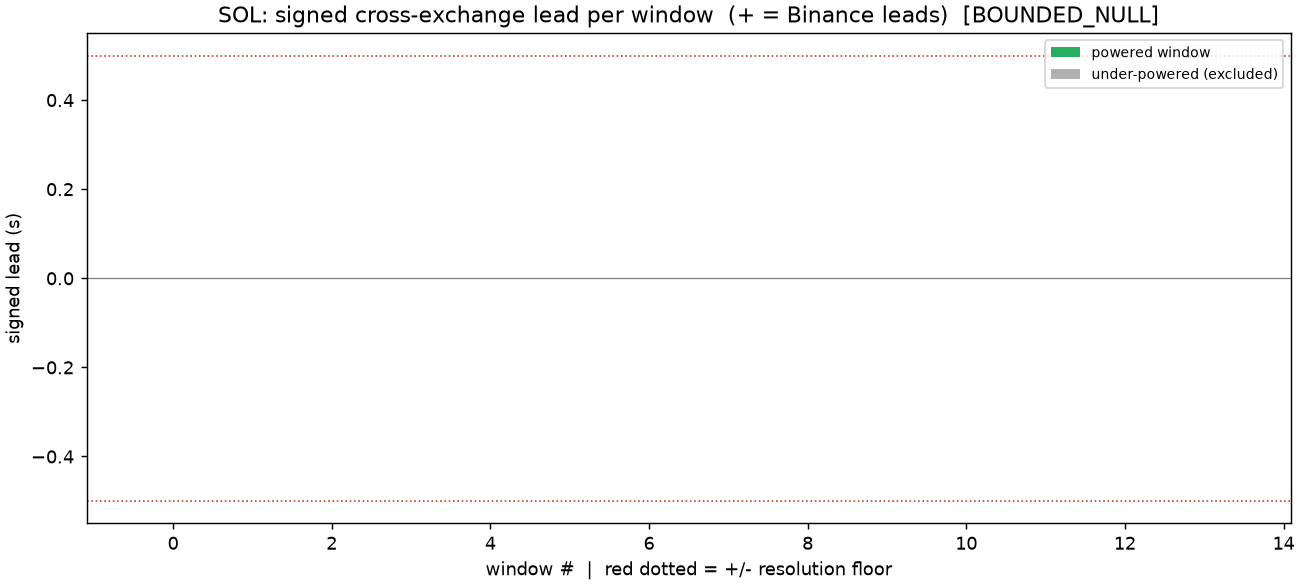
Across all 14 windows — Coinbase spacing ranging from about 0.9s down to 0.07s — the estimated lead was 0.00s in every one. Five windows cleared the power gate, and the verdict is drawn only from those. The pre-registered resolution floor was 0.5s (set from the sparser venue’s typical tick spacing); in the densest powered windows Coinbase ticked as fine as ~0.08s — dense enough that the estimator’s own 0.25s grid step, rather than data sparsity, became the binding limit — and the lead still read zero there. So the zero is genuine synchrony, not an artifact of coarse sampling. Cross- venue correlation was modest and variable (roughly 0.3–0.65), reflecting real tick-level divergence between the venues rather than sparsity alone — but what co-movement exists is contemporaneous. We attempted denser venues to sharpen the bound further; one was unreachable and the others too sparse, so a fraction of a second is the finest free public tick data resolves.
What this means
The hypothesized contrast does not appear: a liquid altcoin is priced across the two venues together, to within a fraction of a second, just as BTC is. That is a null — and reporting it cleanly, at a stated resolution, is the point. The same instrument that quantifies genuine structure when it exists (as in our perpetual-basis study, where SOL stood apart) here looks hard for a lead and correctly finds none.